Fall is here, and caregiving, aging, and patient advocacy initiatives are picking up delicious pumpkin-scented steam as we head into the midterm elections. Here are some action-packed updates on caregiving, aging, and patient advocacy.
1. Researchers react to funding cuts with renewed interest in collaboration
It’s no secret that researchers are facing unprecedented funding barriers after the Department of Government Efficiency’s 2025 slash-and-crash approach to scientific research funding. Scientists are looking for new, creative ways to allocate resources and avoid duplication of efforts in an increasingly competitive funding landscape. Recent news indicates that the current landscape requires collaboration or collapse, with conferences and projects focused on working together to move scientific agendas forward.
The 4th Biennial Conference on Caregiving Research, hosted by the University of Utah in late September, drew more than 300 family caregiving researchers, including 80+ trainees interested in the field. LinkedIn chatter described the value of meeting with the “who’s who” of caregiving-specific researchers. Conference co-chair Dr. Erin Kent of UNC described the conference as unique because it “centers caregivers and caregiving” across disciplines, health context, and lifespan, with a focus on both the rigor of research and the translation of evidence into practice. As Rachel Cannady, Senior Associate Director of the Carter Center, said, “there is something special about being among the caregiving ‘family'” of researchers who share a common purpose in improving the lives of families.
From a global perspective, European aging societies are working together to study the biology of aging. For a community that has more often assigned “aging” to the social sector, researchers are coming together for the first time to study the biomedical impact of longevity. The newly founded European Federation for Aging Research (EFAR) unites German (DGfA), Dutch (DUSRA), Nordic (Nordic Aging), and British (BSRA) societies for aging research to “form a structure for scientific exchange, support young scientists entering the field, promote aging research, and advance policy.” They’ll meet in mid-October and encourage other European researchers and institutions to reach out. They set their vision as a “united European voice for the science of aging,” not unlike the World Dementia Council or US-based leaders such as the Alliance for Aging Research and the Stanford Center on Longevity.
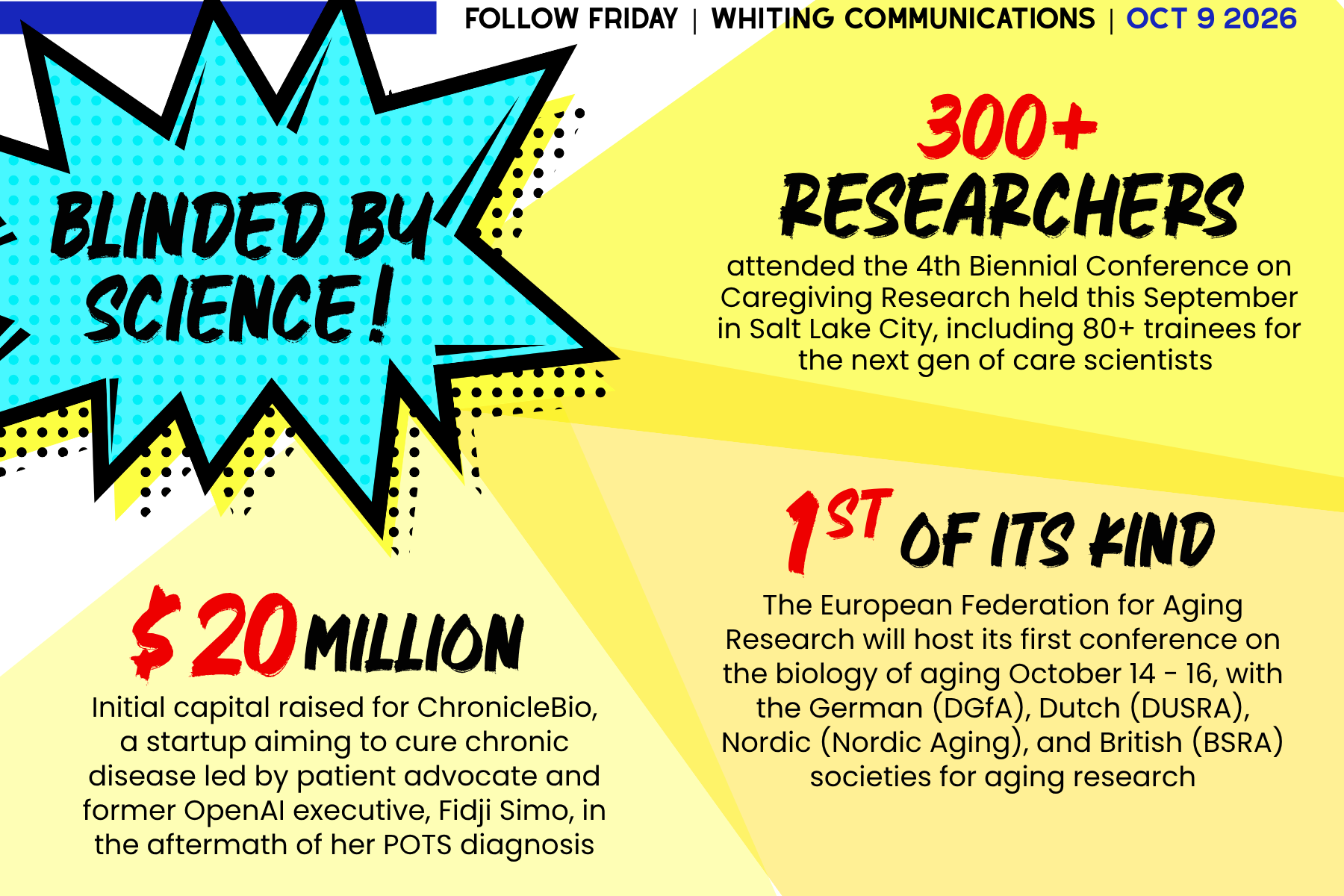
Finally, a former Silicon Valley executive, Fidji Simo (most recently of OpenAI) has been making headlines with a startup she has co-founded after leaving industry to address the challenge of chronic disease. ChronicleBio makes the case that by bringing “together data, biology, and intelligence” through an artificial intelligence platform, it can “reveal insights hidden within complex chronic disease.”
Certainly, the use of AI to supercharge research in an era when funding is dwindling and collaboration is key makes sense from a policy perspective. As the Center for European Policy Analysis (CEPA) describes, “The marriage of AI and biology is changing the economics and speed of biological research.” Google, Anthropic, and OpenAI have all built AI platforms to accelerate biotech and clinical science innovation. Likewise, Ms. Simo has an authentic commitment to this project, as she has openly talked about managing her career in the wake of her POTS diagnosis. Noting that she can’t sit or stand for “more than five or 10 minutes” without passing out, it’s amazing what she’s accomplished in her career at OpenAI, as Instacart’s former CEO, and at Meta. (I can’t help but think of the incredible women at the Chronic Boss Collective when reading about Ms. Simo’s experiences on INC and Forbes).
Still, the project depends on developing an extensive biobank of blood samples, and the $20 million in existing funding seems shy of true investment in the chronic disease state. Are folks willing to pony up their blood in a post-Theranos world? October will also be the debut of A24’s new Elizabeth Holmes documentary, which has been widely memed online and continues to capture public consciousness in any conversation about women and biotech startups.
2. Caregiving doesn’t kill you… it makes you stronger?
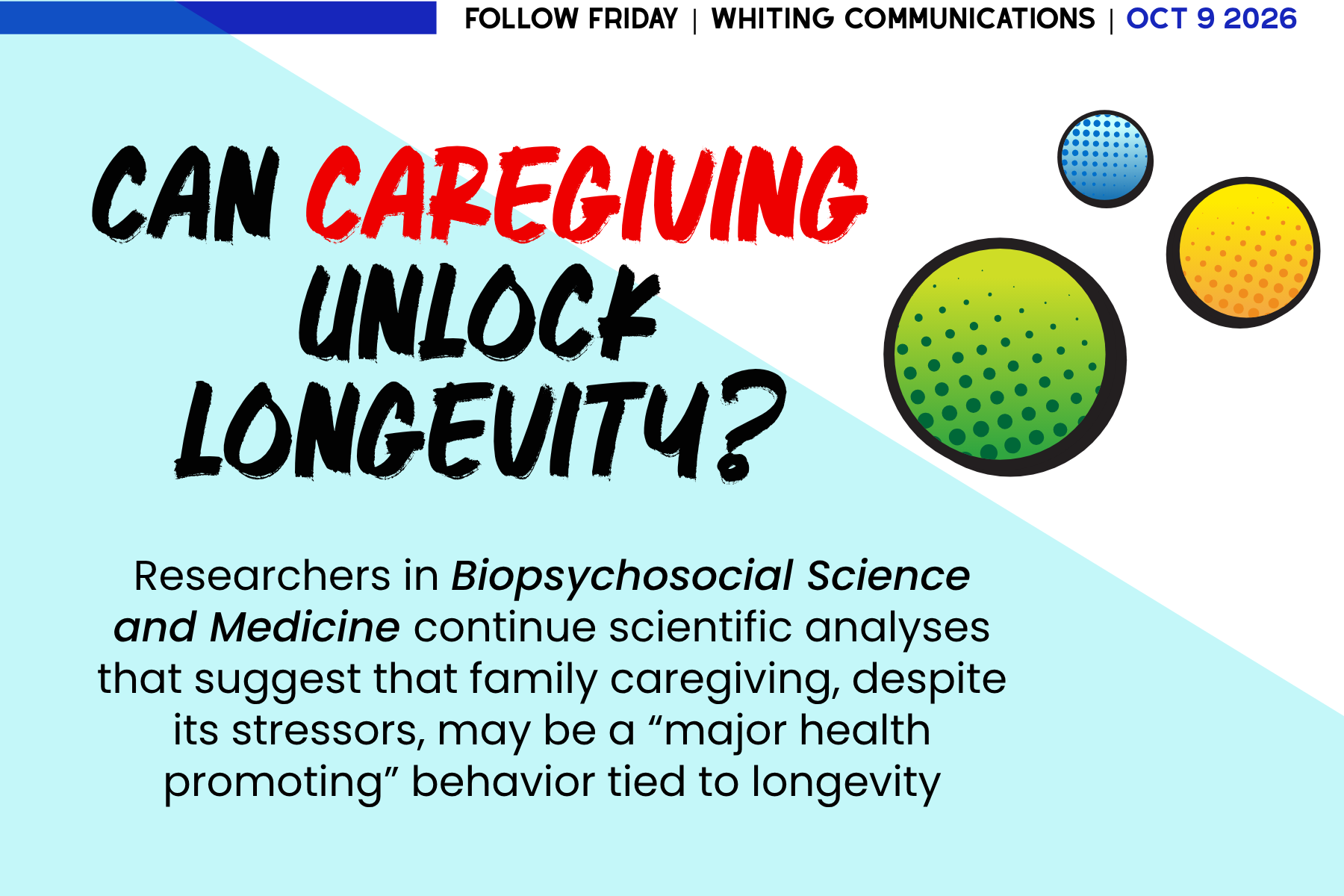
There’s renewed interest in the debate on whether the stresses of caregiving are a health risk to the caregiver or whether the activities and skills developed as a family caregiver instead provide a health-protective benefit. I’m reminded of research from Johns Hopkins published back in 2013, the subject of which was many hushed whispers and collective raised eyebrows. It claimed that people who are family caregivers may live longer than people who aren’t. Or, to put it in their more nuanced, researcher language: “Providing care to a family member with a chronic illness or disability is not associated with increased risk of death in most cases, but may instead be associated with modest survival benefits for the caregivers.”
It’s hard to believe that it’s been 20 years since Justin Timberlake brought sexy back. Just as we welcomed those vibes, the idea that caregiving won’t kill you, but instead make you stronger, is likewise worth revisiting. This time, researchers from the UCLA Department of Psychology are approaching caregiving from a neuroscience perspective. In an abstract published ahead of print in Biopsychosocial Science and Medicine, authors Naomi Eisenberger, Flora Blandl, and Maria Naclerio make an interesting argument: that in studying the negative stressors of caregiving, researchers fail to distinguish the underlying cause of caregiving stress, conflating the positive psychosocial benefits of helping behaviors with the negative emotions and experience of grief, anxiety, and uncertainty in witnessing someone you love struggle with advanced illness or disability.
The best take on this trend is Sujata Gupta’s piece in ScienceNews: Remember the ‘caregiving kills’ study? Reality is more nuanced. Gupta cites the usual suspects, including data from the National Alliance for Caregiving and AARP’s long-running Caregiving in the U.S. study on the breadth and scope of challenges facing caregivers. (Full disclosure: As a former CEO of NAC who worked on two prior versions of that study in 2015 and 2020, I’d be lying if I didn’t admit to some ruffled feathers when people challenge the common perception of caregiving as a problem to be solved.) Still, she makes a compelling argument that failing to acknowledge the nuance of caregiving’s positive health impact means researchers are missing important questions.
3. “Don’t miss events” in patient advocacy this fall
Patient-Centered Outcomes Research Institute (PCORI) Annual Meeting
October 19 – 20, 2026 | FREE! | Online
https://www.pcori.org/annual-meeting/agenda
BIO Patient Advocacy Changemakers Event
October 23 – 24, 2026 | Washington, DC
https://pace.bio.org/
Gerontological Society of America (GSA) 2026 Annual Scientific Meeting
November 4 – 7, 2026 | National Harbor, MD (DC Metro Area)
https://www.gsa2026.org/
Caregiver Nation Summit (National Alliance for Caregiving)
November 17 – 19, 2026 | Washington, DC and Online
National Health Council 2026 Washington Representatives Retreat
November 19 – 20, 2026 | Annapolis, MD (DC Metro Area)
https://web.cvent.com/event/34d3bb2b-23b6-488e-8daa-6a8fbcb70022/summary
4. Good reads to pair with pumpkin bread & hot cider
- Rare mom and biotech expert Sarita Edwards talks about the importance of accessibility in a moving LinkedIn post about taking her son, who lives with Trisomy 18, to high school football games.
- The FDA’s Center for Drug Evaluation and Research recently released its 2025 – 2030 Strategic Plan on accelerating rare disease cures, which pairs nicely with this CNBC article on “the movement to make rare drug development more profitable“
- Health and aging policy wonk Howard Gleckman offers insight into the ongoing debate over the home- and community-based services (HCBS) infrastructure, currently threatened by Medicaid cuts. He breaks down a recent Health Affairs piece from community advocates and providers, offering insight as only a true tax nerd can.
- OncoDaily breaks down the classic 2001 romance, Sweet November, starring Charlize Theron and Keanu Reeves, with a take on the movie’s depiction of cancer, survival, and biomedical progress.
- A new community choir in Harlem, Manhattan, called the Unforgettables, features vocalists who are all living with Alzheimer’s or a related dementia and their family caregivers. Listen and learn more here.
5. October 29: Translating caregiving research to nonacademic settings
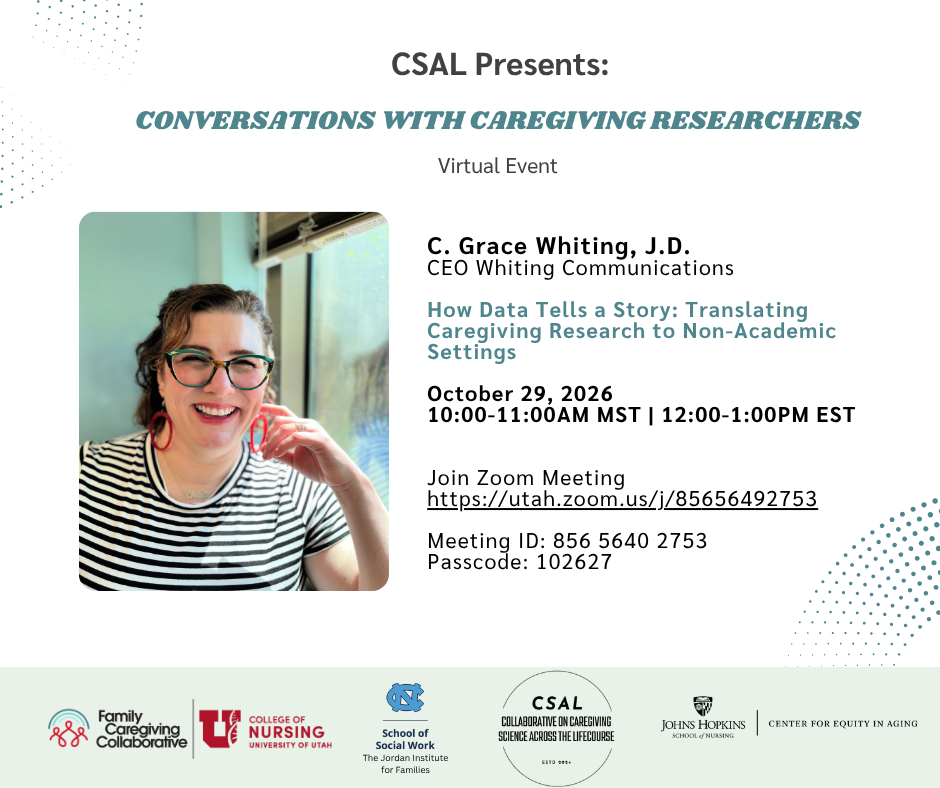
No trick or treat about it! I hope you’ll join me on Thursday, October 29th, to discuss how to use caregiving research for different audiences and purposes beyond the academic audience.
Date/Time & Link
October 29, 2026
10:00-11:00AM MST | 12:00-1:00PM EST
Join Zoom Meeting
https://utah.zoom.us/j/85656492753
Meeting ID: 856 5640 2753
Passcode: 102627
